Showing posts with label digital books. Show all posts

Monday, January 14, 2013

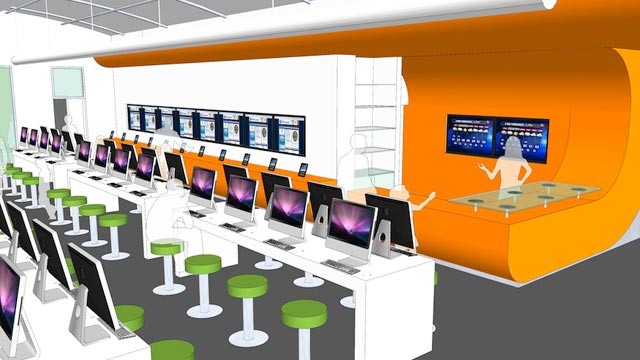
First Bookless Library to Open in San Antonio, TX

Artists conception of Bexar Countys digital only BiblioTech library Bexar County Commissioners Court
Artist's conception of Bexar County's digital-only BiblioTech library (Bexar County Commissioners Court)
We've all wondered when this day would come...

Friday, November 23, 2012

Talk About Speed Reading!

BFS-Auto: High Speed Book Scanner at over 250 pages/min.

This amazing machine would make Evelyn Wood proud. CNET provides a brief description of the technology as well as the company that developed it (Dai Nippon Printing). It's a tremendous boon to preservationists, archivists, and librarians everywhere who value digitizing books and manuscripts. While digitization of printed works in and of itself may be a goal for many, I think the chief value in this is the assurance that these works won't be lost over time through some mishap. We still must protect and guard printed works that exist now - someday they may be considered one of the wonders of the ancient world!

Thursday, October 25, 2012

Young Readers - Not an Oxymoron


Young person demonstrating e-reader
By Sigismund von Dobschütz (Own work)
via Wikimedia Commons
Very heartening news from a Pew report about the reading habits of young people today - the fact that they do read is one of best news at all! And kids don't eschew print books in favor of e-books, which was a bit surprising, but also welcome news. This report contains a wealth of data on youth reading habits, attitudes toward libraries, and format preferences. And along a similar vein, a writer talks about her preference for print books over digital for olfactory reasons, among others! Apparently, books have a certain fragrance that many people find enticing - eau de musty, maybe?

Sunday, October 14, 2012

Again, the Value of Paper

Antique books by Liam Quin Wikimedia Commons
Antique books by Liam Quin, Wikimedia Commons
Justin B. Hollander, who is an assistant professor of urban and environmental policy and planning at Tufts University, has written an op-ed in the NYT decrying recent calls in the education community for the elimination of print textbooks. He argues that while there is a place for newer, digitized formats, there remains value in using print textbooks since they can be less distracting and more conducive to learning. Studies on the effects of using digital formats for learning have been mixed and despite some positive results, longitudinal studies have yet to be conducted since web and e-reading are still so new. Hollander effectively describes the ill-effects of replacing time-tested methods of doing various tasks with new technologies that wreak havoc in other areas of our environment. A good example is the national highway system replacing railways and cable cars, which were less destructive to the environment. Who knows what regrets we may later have if we eliminate print textbooks altogether? Reading from printed matter develops concentration and reinforces learning; it's a longer term process that is less distracting. For myself, I know that I feel different when reading a print book versus a digital book. E-books feel ephemeral and I don't feel I retain what I read, whereas with print books, the words on paper feel permanent and seem to burn themselves in my mind. It feels more like a journey reading a book from end to end; with digital, I find it too easy to switch tasks and look up things on the web or jump around the book with the search feature. Both methods have their place, but I tend to do lesser value reading electronically, with the exception of online newspapers. I rarely read print newspapers anymore, probably because news is so ephemeral, why not just read it electronically since it changes daily? 

Sunday, August 19, 2012

The End of Books?

Antique book
Antique Book
Any article about the end of books will generate considerable buzz on the web, and a recent article in the NYT by Leah Price, no less. What sets Ms. Price's essay apart from so many others is the depth to which she has explored the subject. She is a professor of English at Harvard and a specialist on the history of  books. Ever since technology began its exponential growth, scholars and technophiles alike have predicted the end of books. But this discussion has been sloppy to some extent because people do not distinguish between the written word and its vehicles. In her article, Ms. Price examines the rise of new technologies which were predicted to supplant older ones, but which actually never happened, such as books with radio, and radio with TV. Which all begs the question, is it really about the end of books or of reading? And what will be the ultimate killer of the printed book? Even ereaders, despite their explosive popularity, have their limitations. Any physical medium which requires one to grasp and interact with it will be supplanted by others that will reduce the strain our hands and optic nerves. Maybe a new technology that will simply generate words in front of our eyes, for those who actually still wish to read as opposed to listen to books. And I don't mean by the use of goggles or any device that simply projects words on a screen, but which may be able to transmit them through the optic nerve to our brains. A kind of reverse projector through the eyes. After all, necessity (and laziness) is the mother of invention, so it may happen, as sci-fi authors have often forecasted.